Depok–A cross-disciplinary collaboration combining technology, business, and creativity led Aghnie Prasta—a Media Production student at the Vocational School, Universitas Indonesia (UI)—to secure a Top 5 finish in the RISTEK Hackathon 2026. Together with Muhammad Sultan Zidan (Computer Science, Faculty of Computer Science UI) and Awab Husein (Management, Faculty of Economics and Business UI), Aghnie developed Biotopia, a biology learning platform created to address the issue of limited laboratory access in various schools.
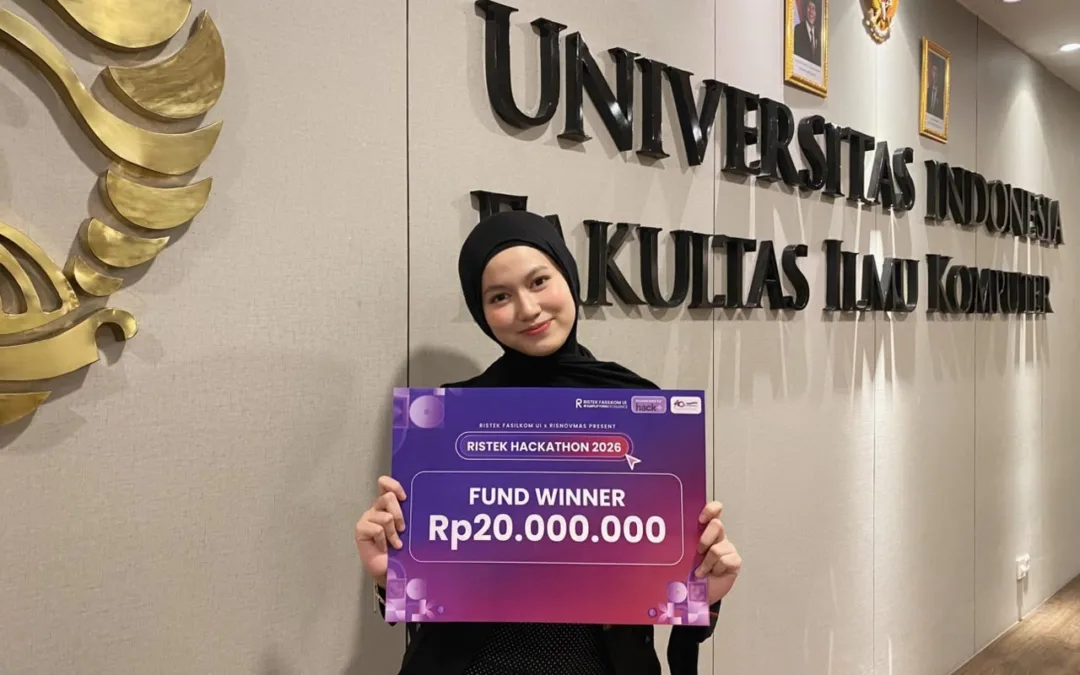
Team Biotopia successfully secured a spot among the top five finalists and obtained IDR 20 million in funding in a competition organized by Fasilkom UI. Furthermore, the proposal developed by the team achieved the highest score during the proposal evaluation stage prior to advancing to the final round.
The RISTEK Hackathon 2026 unfolded across several stages within a relatively short timeframe. Following the close of registration on July 31, 2026, participants proceeded to draft and submit their proposals on August 7. Team Biotopia was subsequently announced as one of the 10 grand finalists on August 9, 2026, and participated in an intensive four-day mentoring program before submitting their final pitch deck on August 13. The competition concluded with an exhibition, final pitching session, and awards ceremony held in person at the Fasilkom UI Auditorium.
In product development, Aghnie and the team divided roles based on the “Hacker, Hipster, and Hustler” concept. Zidan handled application development and machine learning integration. Aghnie was responsible for UI/UX development, visual design, product user flows, and the creation of 3D mockups. Meanwhile, Awab focused on financial planning, business strategy, licensing models for schools, and pitching the concept.
Biotopia was developed to address the limited access to laboratories that many schools still face. The product’s development was partly inspired by the experiences of Mardiana, a biology teacher at SMAN 3 Purwokerto. Based on this issue, the team designed Biotopia around the DAUN concept: Discover, Anticipate, Untethered, and Notice. Through the “Discover” feature, students can study biological subjects using documentation or photos from their immediate surroundings. The “Anticipate” feature encourages students to make predictions and gain an understanding of the subject before obtaining the actual answers. Meanwhile, “Untethered” allows learning to take place offline, and “Notice” enables teachers to monitor the students’ learning process.
For Aghnie, one of the biggest challenges during the competition was completing all development stages within a very tight timeframe. Leading up to the pitching phase, the team had to finish developing the application, create a pitch deck, and prepare presentation materials—all in just four days. “Maintaining creative thinking to design a clean, student-friendly UI/UX while physically exhausted was certainly a challenge in itself. The development window was also extremely short, so we really had to manage our focus and time, as well as set priorities,” said Aghnie.
In the midst of busy competitions, Aghnie also continues to carry out a number of organizational activities. This experience helped him hone his time management, communication and working under pressure skills. The intensive mentoring process carried out for four days before the final pitching was also an important part in the development of Biotopia. Through this session, the team received various input from mentors to sharpen the concept and strengthen the solutions offered.
 (Photo: The Biotopia team, consisting of three students from various disciplines)
Although still in the early stages of her university studies, Aghnie already possesses experience in UI/UX, having developed a background in the field during her vocational high school education, where she majored in Software Engineering. She also completed a six-month internship at a design studio to further hone her skills in this area.
According to Aghnie, participating in the RISTEK Hackathon 2026 reinforced her understanding of the importance of trust and interdisciplinary collaboration in developing innovations. Aghnie added, “We came from different fields—Computer Science, Management, and Media Production. However, when everyone focused on their respective areas of expertise and trusted one another, we were able to produce a complete, cohesive product. I also learned that a good idea shouldn’t just remain a concept; it must genuinely address existing problems.”
The Director of the UI Vocational School, Dr. Safrin Arifin, SKM., S.St., M.Sc., commended the achievements of Aghnie and her team, which were realized through multidisciplinary collaboration and the development of technology-based solutions. “The achievements of Aghnie and her team demonstrate that cross-disciplinary collaboration can lead to outstanding success. Competencies in creativity, design, and media can be integrated with technology and business perspectives to produce solutions that address the community’s needs. We hope this experience further encourages UI students to boldly explore ideas, collaborate, and deliver innovations that create a tangible impact,” said Safrin.
The achievements of the Biotopia team demonstrate that collaboration across diverse scientific backgrounds can yield solutions to real-world problems. For Aghnie, participating in the RISTEK Hackathon 2026 was not merely an accomplishment; it also served as an opportunity to test skills, broaden perspectives, and learn how to work collaboratively to transform an idea into a product with the potential for further development.
This experience also reflects the KITA values of the UI Vocational Education Program—Competent, Integrity, Transformative, and Adaptive—demonstrated through the ability to develop competence, foster collaboration, drive innovation, and adapt to challenges in order to produce impactful work.